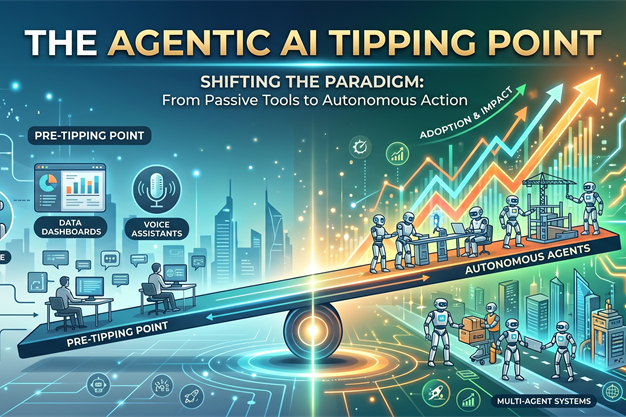
The Agentic AI Tipping Point: From Overhyped Pilots to Trusted Digital Coworkers in 2026
How enterprises crossed the chasm from “AI demos” to autonomous, governed, revenue-generating digital coworkers: a complete implementation guide with architecture, code patterns, and references.
1. The moment everything changed
For three years, “agentic AI” was the most overpromised phrase in enterprise software. Demos dazzled. Pilots stalled. Boards funded experiments that never escaped the lab.
April 2026 looks different. EY's Canvas platform is now processing 1.4 trillion lines of audit data annually across 160,000 engagements in 150+ countries, with agentic orchestration embedded into the workflow of 130,000 professionals. JPMorgan is running 450+ production AI agents daily, generating investment-banking memos in 30 seconds and automating 360,000+ manual hours each year. Salesforce's Agentforce, deployed at Reddit, is reportedly driving 84% reductions in case resolution times and exceeding $100M in annual operational savings.
The CrewAI 2026 State of Agentic AI survey of 500 C-level executives at large enterprises found that 74% now consider production deployment of agentic AI a critical priority or strategic imperative. Not a single respondent said agentic AI had delivered zero benefit.
That is what a tipping point looks like: not a single dramatic event, but the moment the curve bends and the conversation in every boardroom shifts from “should we?” to “how fast can we?”.
But here is the uncomfortable second half of the story: 86–89% of enterprise AI agent pilots still fail to reach durable production scale. Gartner separately warns that more than 40% of agent projects will be cancelled by 2027 because of cost overruns, unclear value, and governance gaps. The gap between the winners and the rest is not the model. It is the architecture.
2. What “agentic” actually means (and why it is different)
A traditional generative AI app is a prompt machine: input → model → output. Useful, but reactive.
An agentic AI system is a goal machine. You give it an objective and constraints. It decides what steps to take, which tools to invoke, when to ask a human, and when to stop. It maintains state, recovers from failure, and increasingly collaborates with other agents.
The five capabilities that define a real agent
- Reasoning & planning: decomposing a goal into ordered subtasks.
- Tool use: calling APIs, querying databases, writing files, sending emails.
- Memory: short-term (within a task) and long-term (across sessions).
- Collaboration: handing off to other agents or humans.
- Self-correction: re-planning when a step fails.
Kore.ai summarises the operating loop as Sense → Reason → Act → Learn → Collaborate, and notes that the architectural shift in 2026 is from “LLM-centric setups to Agentic Meshes: composable ecosystems that support multi-agent collaboration and governance.”
3. The reference architecture every enterprise is converging on
After studying dozens of production deployments, a clear pattern emerges. Whether you are at JPMorgan, Salesforce, or a 200-person fintech, the architecture has roughly seven layers.
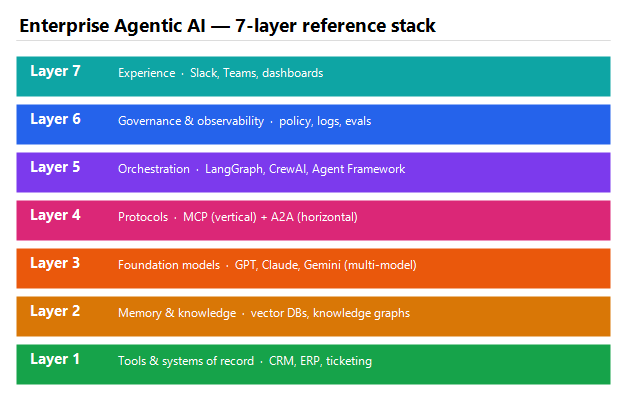
Layer 1: Tools & systems of record
The CRMs, ERPs, ticketing systems, document stores, and SaaS apps that already run the business. Agents are valuable only insofar as they can act on these systems. No integration, no value.
Layer 2: Memory & knowledge
A mix of vector databases (for semantic recall), operational databases (for transactional state), and increasingly knowledge graphs (for structured reasoning across entities). Without persistent memory, every agent session starts from zero.
Layer 3: Foundation models
The reasoning brain. The notable shift in 2026: most large enterprises are now multi-model. Salesforce's Agentforce defaults to a managed mix that currently includes GPT-4o with optional Anthropic Claude routing via AWS Bedrock. Choosing one model and locking everything to it has become a strategic anti-pattern.
Layer 4: Protocols (the breakthrough layer of 2026)
This is where the industry actually grew up. Two open protocols now form what FifthRow calls the “two-layer backbone of risk-managed, scalable agentic ecosystems”:
- MCP (Model Context Protocol): Anthropic's open standard for connecting agents to tools and data, now governed by the Linux Foundation. By April 2026, MCP runs on 10,000+ enterprise servers, with 97M+ SDK downloads, adopted by Anthropic, OpenAI, Google, Microsoft, and AWS. Think of it as USB-C for AI tools.
- A2A (Agent2Agent Protocol): Google's protocol for secure, structured agent-to-agent delegation. As of April 2026, it is used in production by 150+ organisations, mostly hyperscale cloud and SaaS ecosystems.
The mental model that is winning: MCP is vertical (agent → tool); A2A is horizontal (agent ↔ agent). Together, they break vendor lock-in and make multi-vendor orchestration possible.
Layer 5: Orchestration
This is where frameworks like LangGraph, CrewAI, Microsoft Agent Framework (formerly AutoGen + Semantic Kernel), and BeeAI live. They handle agent definition, task decomposition, handoffs, and state. A 2026 benchmark across 2,000 runs found LangGraph the most stable for complex stateful workflows, CrewAI the cheapest at $0.12–0.15/query, and LangChain the most production-mature with 500+ integrations.
Layer 6: Governance & observability
The layer that 86% of failed pilots underinvest in. Policy engines, full audit logs, eval harnesses, prompt-injection defences, PII redaction, and human-in-the-loop checkpoints. CrewAI's 2026 survey found that 34% of enterprise leaders rank security and governance as the #1 evaluation criterion for agent platforms, well above ROI itself. That ranking is rational: without trust, ROI never compounds.
Layer 7: Experience
The surface where humans meet agents: Slack, Teams, email, custom dashboards, voice. Increasingly, the surface is invisible: agents simply do work and notify humans only when they hit an approval gate.
4. End-to-end implementation: a “Customer Operations” digital coworker
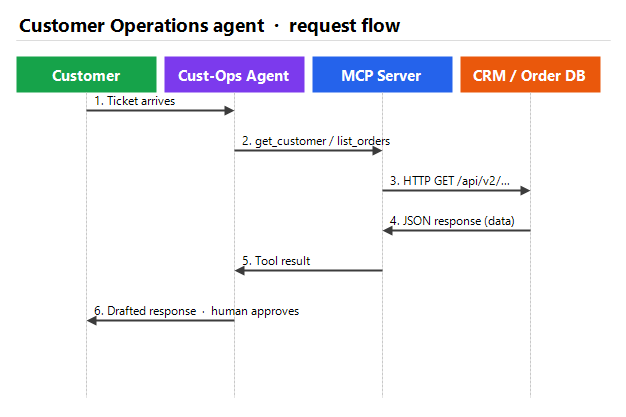
To make the architecture concrete, here is the implementation pattern most enterprises are using to ship their first production agent. The use case: a Customer Operations Agent that triages support tickets, looks up order history, drafts responses, and escalates the hard cases.
4.1 The agent topology
4.2 Step 1: Environment & dependencies
# Python 3.11+ recommended
python -m venv .venv
source .venv/bin/activate

pip install --upgrade pip
pip install \
  "langgraph>=0.2" \
  "langchain>=0.2" \
  "langchain-anthropic" \
  "crewai>=0.70" \
  "mcp>=1.0" \
  "langfuse" \
  "pydantic>=2" \
  python-dotenv
A .env file with the model and observability keys:
ANTHROPIC_API_KEY=sk-ant-...
LANGFUSE_PUBLIC_KEY=pk-...
LANGFUSE_SECRET_KEY=sk-...
LANGFUSE_HOST=https://cloud.langfuse.com
4.3 Step 2: Expose your CRM as an MCP server
This is the integration moment. Instead of hard-coding API calls inside the agent, you wrap your CRM in a tiny MCP server. Every agent, now and forever, calls it through a single, governed interface.
tools/crm_mcp_server.py
from mcp.server.fastmcp import FastMCP
import httpx

mcp = FastMCP("crm-server")

@mcp.tool()
async def get_customer(customer_id: str) -> dict:
    """Fetch a customer profile by ID."""
    async with httpx.AsyncClient() as client:
        r = await client.get(
            f"https://crm.internal/api/v2/customers/{customer_id}",
            headers={"Authorization": "Bearer ${CRM_TOKEN}"},
        )
        r.raise_for_status()
        return r.json()

@mcp.tool()
async def list_recent_orders(customer_id: str, limit: int = 5) -> list[dict]:
    """Return the customer's most recent orders."""
    async with httpx.AsyncClient() as client:
        r = await client.get(
            f"https://crm.internal/api/v2/customers/{customer_id}/orders",
            params={"limit": limit},
        )
        return r.json()

if __name__ == "__main__":
    mcp.run()
That is it. You now have a tool surface that any MCP-aware agent (Claude Desktop, an internal LangGraph agent, a partner's Microsoft Copilot) can discover and call with consistent auth and audit.
4.4 Step 3: Add governance
governance/guardrails.py
from presidio_analyzer import AnalyzerEngine
from presidio_anonymizer import AnonymizerEngine

analyzer = AnalyzerEngine()
anonymizer = AnonymizerEngine()

INJECTION_MARKERS = ["ignore previous", "system prompt", "</system>"]

def sanitize(text: str) -> str:
    if any(m.lower() in text.lower() for m in INJECTION_MARKERS):
        raise ValueError("Possible prompt injection")
    findings = analyzer.analyze(text=text, language="en")
    return anonymizer.anonymize(text=text, analyzer_results=findings).text
Every input passes through sanitize() before reaching an LLM. Every tool call is logged to Langfuse (or Datadog, or LangSmith) with the prompt, the tool arguments, the latency, and the cost. Without this layer, you have no story to tell auditors and no path to scale beyond the pilot.
4.5 Step 4: Evaluate before shipping
The single biggest cause of pilot failure is shipping without an eval suite. Run a deterministic test suite on every pull request and block deploys below your accuracy floor. Sky's the limit on what you add later (promptfoo, LangChain AgentEvals, custom regression dashboards), but a deterministic test suite is non-negotiable.
5. Use cases that are actually delivering ROI in 2026
Not every shiny demo becomes a production system. The use cases below have named companies, defined KPIs, and verified outcomes, drawn from deployments published between 2025 and 2026.
| Industry | Company | Use case | Outcome |
|---|---|---|---|
| Financial services | JPMorgan Chase | M&A memo drafting, fraud detection, compliance reporting | 450+ production agents; 360,000+ manual hours automated/yr; ~20% compliance efficiency gain |
| Financial services | Klarna | Customer-service agent (Tier-1 resolution) | $60M saved; absorbed workload of 853 FTEs by Q3 2025 |
| Wealth management | Morgan Stanley | Post-meeting notes & CRM sync for advisors | 98% voluntary advisor adoption |
| Customer experience | Reddit on Salesforce Agentforce | Tier-1 case resolution | 84% reduction in case-resolution times; $100M+ annual savings |
| Retail | Walmart | Trend-to-Product multi-agent system | Compressed concept-to-prototype timelines |
| Audit & advisory | EY (Canvas) | Federated audit orchestration | 1.4T audit lines/yr across 160K engagements |
| Banking compliance | Multiple banks (per McKinsey) | KYC / AML automation | 200%–2,000% productivity gains |
The pattern across all winners is identical: scoped use case + connected data + defined KPI + human escalation path. Vague mandates (“modernise our service desk with AI”) consistently produce the failed 86%.
6. The benefits for organisations and for clients
For the organisation
- Cycle-time compression. What took days takes minutes. JPMorgan generates investment-banking decks in 30 seconds.
- Cost-structure shift. 69% of CrewAI survey respondents cite significant operational cost reductions; 59% report lowered labour costs.
- Margin expansion. McKinsey: 12–14 point EBITDA margin increases for AI-centric organisations.
- Talent leverage. Engineers move from writing code to curating a portfolio of agents. The gain is cognitive: fewer handoffs, less context switching, more time on high-judgement work.
- Continuous operations. Agents do not sleep, do not forget, do not have bad mornings.
For the end client (or customer)
- Faster resolution. Hours collapse to minutes for simple cases.
- 24/7 availability in any language, any time zone.
- Consistency. No “luck of the draw” on which rep you got.
- Personalisation at scale. The agent sees the full customer history every time, without rummaging through five tabs.
- Better human time when needed. When the agent escalates, the human starts with full context, not “let me pull up your account, sir.”
7. The five failure modes and how to design against them
WRITER's 2026 enterprise AI adoption survey found 79% of organisations now face challenges in AI adoption, a double-digit increase year-over-year, and 54% of C-suite executives admit AI adoption is “tearing their company apart”. The failures cluster:
- Governance vacuum. 67% of executives believe their company has already suffered a data leak from an unapproved AI tool. 36% have no formal plan for supervising agents. Fix: policy engine, audit log, and human-in-the-loop gates from day one, not retrofitted.
- Integration debt. Agents that cannot reach the systems of record are toys. Fix: build MCP servers for your top-five enterprise systems before building any agent.
- No eval harness. Teams ship on vibes, then discover regressions in production. Fix: a deterministic eval suite that blocks merges below an accuracy floor.
- Vendor lock-in at the model layer. Single-model architectures look fast in week one and trap you by month twelve. Fix: abstract model calls behind a router; keep at least two providers production-ready.
- Cultural rejection. Only 35% of employees say their manager is an AI champion; 80% of Gen Z trust AI more than their manager for certain tasks. Fix: train managers first, give frontline employees the power to build their own agents (the “super-user” pattern), and make AI fluency a promotion criterion.
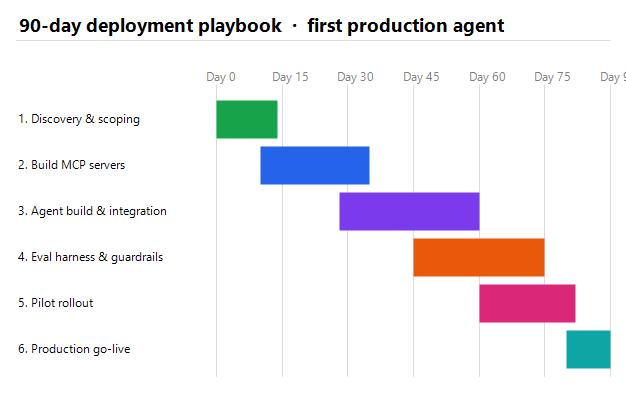
8. A 90-day deployment playbook
Based on the patterns shared by FifthRow, Joget, and the CrewAI 2026 report, here is a realistic timeline for a first production agent at a mid-to-large enterprise.
Three rules that separate the 14% who reach production from the 86% who do not
- Pick one workflow with a number on it. “Reduce avg ticket-resolution time from 6h to 1h” beats “transform customer service” every time.
- Build the integration layer (MCP servers) before the agents. Reusable plumbing compounds; bespoke plumbing rots.
- Make governance a feature, not a tax. A real-time policy engine that blocks a non-compliant action is worth more than a 200-page policy document nobody reads.
9. Looking ahead: what to watch in late 2026 and 2027
- Standard convergence. Expect MCP and A2A to converge transports (HTTP+SSE today, likely a unified streaming standard) and to gain mandatory regulatory hooks under the EU AI Act and equivalents.
- Agents in the C-suite. 75% of executives expect AI agents will be part of their company's C-suite within five years, a phrasing that sounds absurd until you realise they mean as advisors, not as voting members.
- From copilots to autonomous coworkers. 2024 was about assist. 2026 is about act. 2027 will be about own: agents accountable for outcomes, not just output.
- Failure rates will fall, but so will tolerance. Today's 86% failure rate will improve as the toolchain matures. But a board that has seen one peer ship will not accept another year of pilots.
10. The real lesson
The tipping point of 2026 is not that agentic AI suddenly works. It is that the boring infrastructure around it (MCP, A2A, governance frameworks, eval harnesses, observability tooling) has finally matured enough that disciplined teams can ship without heroics.
The organisations winning right now are not the ones with the best models. They are the ones who treated agentic AI like any other piece of mission-critical software: scoped use cases, connected data, defined KPIs, real evals, real audit logs, real escalation paths.
Trusted digital coworkers are not built in a demo. They are built in the seventh boring sprint, where someone finally writes the eval that catches the silent regression that would have cost the company six figures.
That is what crossing the chasm looks like. And in 2026, the bridge is finally crowded.
References
- CrewAI, 2026 State of Agentic AI Survey Report, February 2026, crewai.com/blog/the-state-of-agentic-ai-in-2026
- FifthRow, AI Agent Orchestration Goes Enterprise: The April 2026 Playbook
- Architecting the Agentic Enterprise: MCP, AI Gateway & A2A at the Core, 2025
- AI Monk, 12 Agentic AI Examples With Measurable ROI, 2026
- Joget, AI Agent Adoption 2026: What the Data Shows, March 2026
- Kore.ai, What is Agentic AI? Use Cases and How It Works (2026)
- Kai Waehner, Enterprise Agentic AI Landscape 2026
- Anthropic, Model Context Protocol Specification, modelcontextprotocol.io
- Google, Agent2Agent (A2A) Protocol, google.github.io/A2A/
- WRITER, Enterprise AI Adoption in 2026