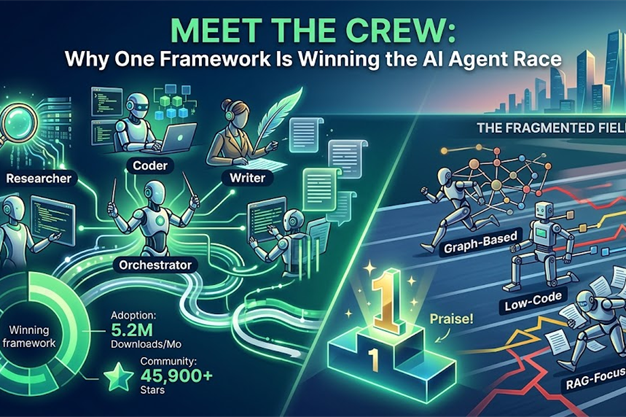
Meet the Crew: Why One Framework Is Winning the AI Agent Race
Three years ago, AI agents were a research curiosity. Today, they are running customer support queues, drafting reports, qualifying leads, and reconciling invoices inside Fortune 500 companies. At the centre of this shift sits a framework that almost no one had heard of in early 2024: CrewAI, which has become the most widely adopted agentic AI framework in the world by making AI agents work the way human teams already work.
What CrewAI Is
CrewAI is an open-source platform for building and managing teams of AI agents. Founded in late 2023 by João Moura, it has grown from a side project into one of the fastest-rising names in enterprise AI, backed by Insight Partners, ranked No. 4 on the 2026 Enterprise Tech 30 Early Stage list, and used by developers in more than 150 countries. Instead of building one massive AI system that tries to do everything, CrewAI lets you assemble a crew of specialised agents (each with a defined role, goal, and set of tools) that hand work to one another the way a real team would.
Why CrewAI Is Pulling Ahead
Several forces explain CrewAI's rapid rise relative to other frameworks in the market.
1. Built for non-technical teams as well as engineers
Most agentic frameworks were designed by engineers, for engineers. CrewAI offers both a code-first path for developers and a visual editor with an AI copilot for business users. This dual approach matches what enterprise buyers are asking for, and the demand for low-barrier platforms has never been higher.
2. Scales from prototype to production
CrewAI's open-source framework now sees roughly 5 million downloads per month and over 2 billion agent executions in the past year alone. Around that core sits CrewAI AMP, a managed enterprise platform offering observability, governance, and centralised control. Companies report development time reductions of up to 90% on critical workflows.
3. Avoids vendor lock-in
CrewAI is model-agnostic and infrastructure-agnostic. Teams can run it on any cloud, with any large language model, integrated with whatever tools they already use, including Slack, Salesforce, Gmail, internal databases, and more. For enterprises wary of betting their AI strategy on a single vendor, this flexibility is a significant draw.
Where CrewAI Delivers the Most Value
Based on enterprise deployments to date, CrewAI tends to shine in four areas where multi-step work benefits from specialisation, judgment, and collaboration:
1. Sales and Marketing Operations
Lead enrichment, campaign personalisation, competitive research, and content generation, where role-based collaboration mirrors existing team structures and accelerates output.
2. Market and Competitive Intelligence
Agents that autonomously gather, synthesise, and forecast market dynamics on a continuous basis, replacing one-off research projects with always-on insight.
3. Finance and Operations
Automated reporting, compliance checks, and detailed financial analysis that would otherwise require hours of manual effort across analysts and reviewers.
4. Customer Support
Tiered agent crews that handle routine queries, escalate complex ones, and maintain consistent service quality at scale across channels.
Challenges and Considerations
No framework is a silver bullet. Enterprises adopting agentic AI consistently report obstacles around data readiness and integration, internal talent, technology limitations, and budget. Deploying agentic AI well requires clean data, integration discipline, and a team that understands both the business context and the technology. The framework matters, but the surrounding execution matters more. Organisations that succeed treat agent deployment as a strategic capability, not a one-off project.
The Outlook
Agentic AI is on a trajectory similar to cloud computing in the early 2010s, moving rapidly from differentiator to default. Deloitte projects that by 2027, half of all enterprises using generative AI will be deploying autonomous agents, double the rate from 2025. Within that landscape, CrewAI has earned its position by combining accessibility with enterprise readiness: intuitive enough for a marketing manager to grasp, powerful enough to run mission-critical workflows, and open enough to fit any technology stack.
Conclusion
CrewAI represents a practical first step for most organisations evaluating multi-agent AI. By mirroring how human teams already work, it shortens the path from idea to production and makes agentic AI accessible to both engineers and business users. As enterprises move from experimentation to scaled deployment, frameworks that combine flexibility, openness, and enterprise readiness, like CrewAI, are well positioned to define the next chapter of AI in business.