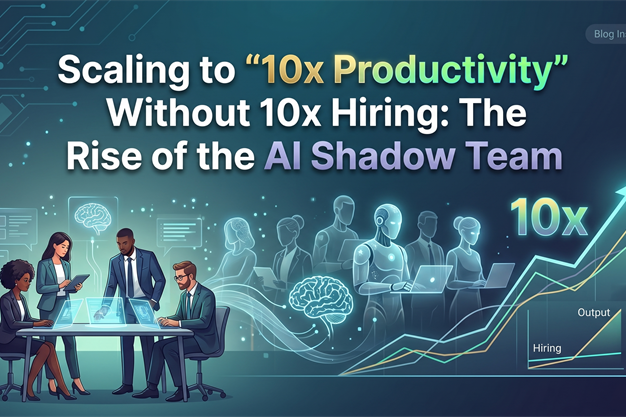
Scaling to “10x Productivity” Without 10x Hiring: The Rise of the AI Shadow Team
In the traditional business model, scaling productivity was a linear equation: if you wanted 10x the output, you typically needed 10x the headcount. In 2026, the math has changed. As highlighted in the Deloitte 2026 State of AI Report, worker access to AI rose by 50% in 2025, and we are entering the era of Agentic AI, where systems don't just answer questions but execute goals. The implication for startups and BizOps leaders is striking: a team of 15 can now operate with the operational muscle of a 150-person corporation, not through brute-force automation but through the deployment of what is increasingly called an AI Shadow Team.
The AI Shadow Team is not a single product or a single agent. It is a coordinated set of agents that mirrors the structure of a human organisation, but at machine speed. Understanding how these teams are designed, onboarded, and held accountable is what separates organisations getting genuine leverage from those whose AI experiments stay stuck at demo quality.
Agent Orchestration: The “Manager” and the “Swarm”
The most significant leap this year is the move toward Multi-Agent Systems. Rather than a human managing five different AI tools side-by-side, a Manager Agent now orchestrates a swarm of specialised sub-agents. The Manager takes a high-level goal, for example, "Research and draft a 50-page market entry report for Australia," and breaks it into discrete, ordered sub-tasks, each with a clear owner and acceptance criteria. From there, the Manager delegates the data scraping to a Researcher, the synthesis to a Writer, and the data visualisation to a Designer, with each agent operating in its own context, role, and toolset.
The result is a working pattern that compresses a multi-week human effort into hours. The human lead steps back into the role of a Director rather than a Doer, reviewing the plan, approving the output, and intervening only at the points where judgment, taste, or accountability is required. The mental model shifts from "managing tools" to "managing teammates," and the productivity ceiling rises accordingly.
Onboarding “Digital Employees” with KPIs
In 2026, leading firms treat AI agents as Digital Employees rather than as features inside a product. Gartner predicts that by 2028, 15% of everyday business decisions will be made autonomously by AI agents, and scaling effectively requires a formal onboarding process to match. Just like a regular hire, each agent needs a clearly defined scope. You don't simply "buy AI"; you "hire" an AI Accounts Payable Specialist, with the same clarity of role, expectations, and reporting line that you would give a human in that seat.
Once onboarded, agents are managed through KPIs and performance reviews. Organisations are using AI Governance Platforms to monitor agent performance, and when an agent's accuracy in classifying invoices drops below 98%, it undergoes "re-training" (fine-tuning) much like a human performance plan. Deloitte emphasises that while agents are outpacing their guardrails, governance is non-negotiable: every AI Shadow Team needs a human supervisor who reviews and approves the agent's plan before execution, particularly for any decision with financial, legal, or customer-facing consequences.
The Cost of “Context”: Data-First BizOps
The biggest barrier to 10x productivity isn't the AI. It's the data. An AI agent is only as effective as the context it can access, and Deloitte notes that while 42% of companies feel their strategy is ready, they feel much less prepared on infrastructure and data management. For an agent to handle international vendor payments or office logistics in any meaningful way, it needs a single source of truth. If your data is siloed in PDFs, Slack threads, and outdated spreadsheets, the agent will either hallucinate or fail outright, and trust will collapse.
This is why modern BizOps teams are quietly investing in what is being called the Sovereign AI stack: localised data environments where agents have full context of company history, compliance requirements, and past decisions, without that data ever leaving the secure corporate firewall. The unglamorous work of cleaning, structuring, and routing data to where the agents need it is what separates the organisations getting real leverage from those whose pilots stall.
Conclusion
Scaling to 10x is no longer only about recruitment; it is about architecture. By building a robust orchestration layer, treating agents as accountable team members, and unifying operational data, a startup can achieve outsized scale while maintaining a lean team. The AI Shadow Team is more than a productivity hack. It is the operating model that will define competitive startups for the next decade. The organisations that move first will capture the leverage; those that wait will spend the same period playing catch-up. The opportunity is open now, and the architecture is within reach.