RIP Prompt Engineering. Welcome, Context Engineering.
The flashy job title of 2023 is quietly buried. What’s replacing it is harder, less glamorous, and far more important.
For a brief, shining moment, “prompt engineer” was the job everyone wanted. Six-figure salaries floated across LinkedIn. Twitter threads promised that the right incantation, like “You are an expert…”, “Take a deep breath…”, or “Think step by step…”, could unlock superhuman performance from any language model. Bookstores filled with prompt cookbooks. Bootcamps appeared overnight. Recruiters who six months earlier didn’t know what an LLM was started asking candidates for their “best prompts.”
That era is ending. Not with a bang (language models are more capable than ever), but with a quiet recognition: the people building the most useful AI products aren’t winning by writing cleverer prompts. They’re winning by engineering in a better context.
Welcome to the post-prompt-engineering era. Welcome to context engineering.
What Prompt Engineering Was (And Why It Worked, For a While)
Prompt engineering was a craft born of necessity. Early large language models were powerful but skittish. GPT-3 in 2020 could write a sonnet or hallucinate a citation with equal confidence. Getting reliable output meant coaxing the model with carefully phrased instructions, role-playing setups, few-shot examples, and a folklore of magical phrases.
For a while, this craft genuinely mattered. The difference between “Write an email” and “You are a professional executive assistant. Write a concise, polite email declining a meeting invitation. Use the following format…” was the difference between gibberish and a useful draft. People who internalized this developed a real edge.
But here’s the uncomfortable truth: most of what made early prompt engineering valuable was compensating for model weakness. The “tricks” worked because the models needed scaffolding to behave. As models improved, the scaffolding got less load bearing. Telling Claude or GPT-4 to “think step by step” in 2023 sometimes helped. Telling a frontier model in 2026 the same thing is, at best, redundant. The model already does that. At worst, it’s noisy.
Prompt engineering didn’t die because it was wrong. It died because it was narrow. It treated the model as the bottleneck. Today, the model is rarely the bottleneck. The information you give the model, and how you structure it, almost always is.
What Context Engineering Actually Is
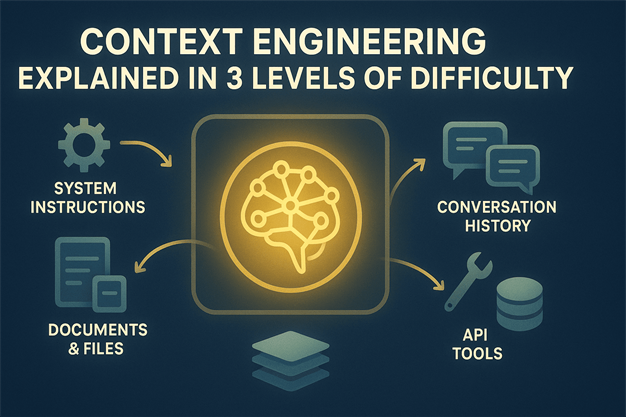
Context engineering is the discipline of designing everything that fills a model’s context window so that it produces the behavior you want. The prompt is just one ingredient. The full menu includes:
- System instructions: persistent rules, persona, output format, refusal policies.
- Retrieved documents: the right chunks from your knowledge base, in the right order, with the right metadata.
- Tool definitions and outputs: what tools the model can call, how their results are formatted, and how those results are summarized for downstream turns.
- Conversation history: what’s kept, what’s compressed, what’s discarded.
- User memory and profile: preferences, past decisions, durable facts about the user.
- Examples: few-shot demonstrations, but chosen dynamically rather than hardcoded.
- State from the broader system: the current date, the user’s location, the open file in their editor, the contents of their cart.
A prompt engineer asks: what should I write to make the model do X?
A context engineer asks: what does the model need to know, in what form, in what order, to make doing X the obvious next step?
The shift is from authoring strings to architecting information flow.
Why the Shift Is Happening Now
Three forces buried prompt engineering, more or less simultaneously.
The first is that models stopped needing hand-holding. Modern frontier models follow instructions reliably, reason without coaching, and produce structured output without ten paragraphs of XML tag preamble. The marginal value of prompt cleverness has collapsed. The marginal value of giving the model the right information has not.
The second is the rise of agents. A single-turn chatbot is a place where prompt tweaks can shine. An agent that runs for thirty turns, calls a dozen tools, reads files, writes files, and accumulates intermediate results is a place where prompt tweaks are rounding errors. What matters in an agentic system is whether the context window, which fills up fast, contains the relevant information when the model needs to make a decision. That is a context engineering problem from end to end. You can write the most beautifully phrased system prompt ever composed, and your agent will still fail if turn 17’s tool output buried the critical fact under 4,000 tokens of irrelevant logs.
The third is that context windows grew, but attention didn’t scale linearly. Million-token windows are real, but stuffing a million tokens into one is a recipe for slow, expensive, and surprisingly mediocre results. Models exhibit “lost in the middle” behavior. They get distracted by irrelevant content. They sometimes anchor on the wrong example. The skill is no longer “fit everything in.” It’s “fit only what matters in, in the position where it’ll actually be used.”
That is engineering. The word is doing real work.
What Context Engineering Looks Like in Practice
Let me make this concrete. Imagine you’re building an AI customer support agent for a SaaS product.
The prompt-engineering version of this project looks like a 2,000-word system prompt with sections labeled “Persona,” “Tone Guidelines,” “Refusal Policy,” “Output Format,” and a long list of “DO NOT” rules. You spend your week tweaking adjectives.
The context-engineering version of this project barely touches the system prompt. Instead, you spend your week on:
- A retrieval pipeline that pulls the three or four most relevant help-center articles for the user’s question, and does not pull the other 1,200, no matter how tempting it is to “just give the model everything.”
- A user-context module that injects the customer’s plan tier, recent tickets, and current product state, formatted as a compact summary the model can actually scan.
- Tool definitions for “look up order,” “issue refund,” and “escalate to human,” each with crisp descriptions, because a fuzzy tool description causes more failures than a fuzzy system prompt ever did.
- A conversation summarization step that compresses turns 1–10 into a paragraph before turn 11, so the agent doesn’t drown in its own history.
- Evaluation harnesses that catch regressions when any of the above changes.
Notice how little of this is “prompting.” The work is plumbing, retrieval, summarization, and evaluation. It looks suspiciously like normal software engineering, because it largely is normal software engineering, with a probabilistic component sitting in the middle.
The New Skills
If prompt engineering was a craft of words, context engineering is a craft of systems. The skills that matter now look like this:
Information design. What does the model need to see, and in what shape? A well-formatted table beats a paragraph. A summary beats a raw transcript. A diff beats two full files. Context engineers think constantly about signal-to-noise ratio inside the window.
Retrieval and ranking. Most context engineering eventually becomes a retrieval problem. Which documents? Which chunks? In what order? Re-ranked how? This is closer to search engineering than to copywriting.
Memory architecture. What does the system remember between turns, between sessions, between users? How is that memory updated, invalidated, and surfaced? “Memory” isn’t a single feature. It’s at least three different systems (working, episodic, semantic) that need to be designed separately and stitched together carefully.
Tool design. When the model can act on the world, the description and output format of each tool become high-leverage prompts in their own right. A tool that returns 50KB of JSON when the model needed three fields is a context engineering bug, even if no human ever wrote a “prompt” about it.
Evaluation. None of the above is improvable without measurement. Context engineering teams obsess over evals (small, focused, fast) that tell them whether yesterday’s change made things better or worse. This is the part that prompt engineering culture often skipped, and the part that separates a working production system from an impressive demo.
Token economics. Every token in your context costs latency, money, and attention. A context engineer treats the window like a budget, not a buffet.
What This Means for Teams
If you’re a founder, an engineering leader, or a developer building on top of LLMs, this shift has practical consequences.
Stop hiring “prompt engineers.” That title was always a bit of a fiction, and the skill it described is now table stakes for any engineer working with these models. Hire engineers who think in systems, who know retrieval, who instrument what they ship, and who can stomach the unglamorous work of formatting tool outputs cleanly.
Stop treating the system prompt as the product. It’s not the product. It’s a config file. The product is the entire pipeline that decides what ends up in front of the model on any given turn.
Start investing in evaluation infrastructure earlier than feels reasonable. Context engineering without evals is vibes-based development, and vibes don’t survive contact with real users.
Treat context as a first-class architectural concern. Diagram it. Version it. Code-review changes to it. The teams that do this ship reliable AI features. The teams that don’t ship demos that work in the boardroom and break in production.
A Less Glamorous, More Grown-Up Discipline
There’s something a little sad about prompt engineering’s decline. It was fun. It had folklore, magic words, a sense that anyone with a clever turn of phrase could outperform a PhD. It democratized AI work in a way that was genuinely exciting.
Context engineering is, frankly, less fun. It’s logging, retrieval tuning, schema design, eval suites, token budgets, and arguments about whether to summarize or truncate. It looks more like backend engineering than like creative writing, because that’s what it is.
But this is exactly the trajectory every important technology follows. The early days reward folklore and intuition; the mature days reward systems and discipline. Web development was once a craft of view-source-and-copy; now it’s a profession with frameworks, testing, and architecture. Machine learning was once a craft of clever feature engineering; now it’s a discipline of data pipelines and evaluation. AI engineering is following the same arc, just faster.
Prompt engineering was the first draft. Context engineering is the rewrite, and the rewrite is always less exciting and much, much better.
So pour one out for the magic words. They served us well. The work ahead is harder, quieter, and more consequential. The people doing it well won’t be tweeting their best prompts. They’ll be too busy shipping.
RIP prompt engineering. Welcome, context engineering. The grown-ups have arrived.